The Future Of Software Will Be Defined By Stewardship
This summer, my colleague Diego Lo Giudice and I explored a deceptively simple question: What happens to enterprise software when AI makes software creation abundant? We found a paradox: Get more of what you want, and you also get more of what you don’t want.
Get More Of What You Ask For
AI writes code, generates requirements, builds workflows, creates tests, and accelerates delivery. But creation won’t be the defining constraint: Governing the resulting abundance will be. As creation costs fall, more ideas become economically viable. More teams can build software, more functions can automate work, and more specialized problems can justify digital solutions.
Live With The Consequences Of What You Create
Abundance never produces only excellence. It produces a spectrum of outcomes: Some software creates value, some creates complexity, some should be scaled, and some should never have been built in the first place. That’s why stewardship will become a defining responsibility for technology leaders. Stewardship means inspecting outcomes and deciding what should be promoted, reused, funded, governed, or retired.
Prepare To Decide What Remains
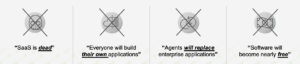
Leaders must prepare now. You will make more decisions about what remains than at any other point in your career. Stop obsessing over whether you can build it; instead, start deciding whether you should own it and, if so, how. At my upcoming keynote in New York, “The Future Of Software,” I’ll explain why stewardship, not creation, will separate leaders from laggards. And I’ll bust some popular myths along the way, such as SaaS is dead, developers are dispensable, and software will become nearly free. Spoiler: There’s no such thing as a free lunch.
I’ll say more at Technology & Innovation Forum East this November 4–5. If you missed our T&I Forum Central in Austin or can’t join us in New York, schedule an inquiry or guidance session with me or Diego.