To Prepare For The Future Of Owned Search, Take Our ADVICE
Search On Apps and Websites Is About To Fundamentally Change — Or Else Users Will Stop Using It
There’s a lot of discussion right now about optimizing content for discoverability in answer engines (the non-owned environment). What’s missing is the part of the conversation that focuses on the owned environment: your sites and apps.
Owned Search Is Headed For A Major Reset
As conversational experiences become familiar, such as in answer engines like ChatGPT and Google Gemini, users (across consumers, buyers, patients, clients, subscribers, constituents, etc.) will expect similar experiences elsewhere. They will want trusted, personally relevant answers, including on the digital properties that organizations own. This is true across every type of organization, from retailers to banks and insurers to government agencies.
Digital leaders must move beyond the chat bubble. They need a practical way to shape unified conversational experiences while preserving the familiar patterns that still work. It’s time for the conversation to move into the search bar and onto the page.
Before we get into it: Join us on October 7 for the webinar, The Future Of Owned Search In Apps And On Websites. You’ll see the data behind our recommendations, dive into the framework, and get practical next steps for you to take right now.
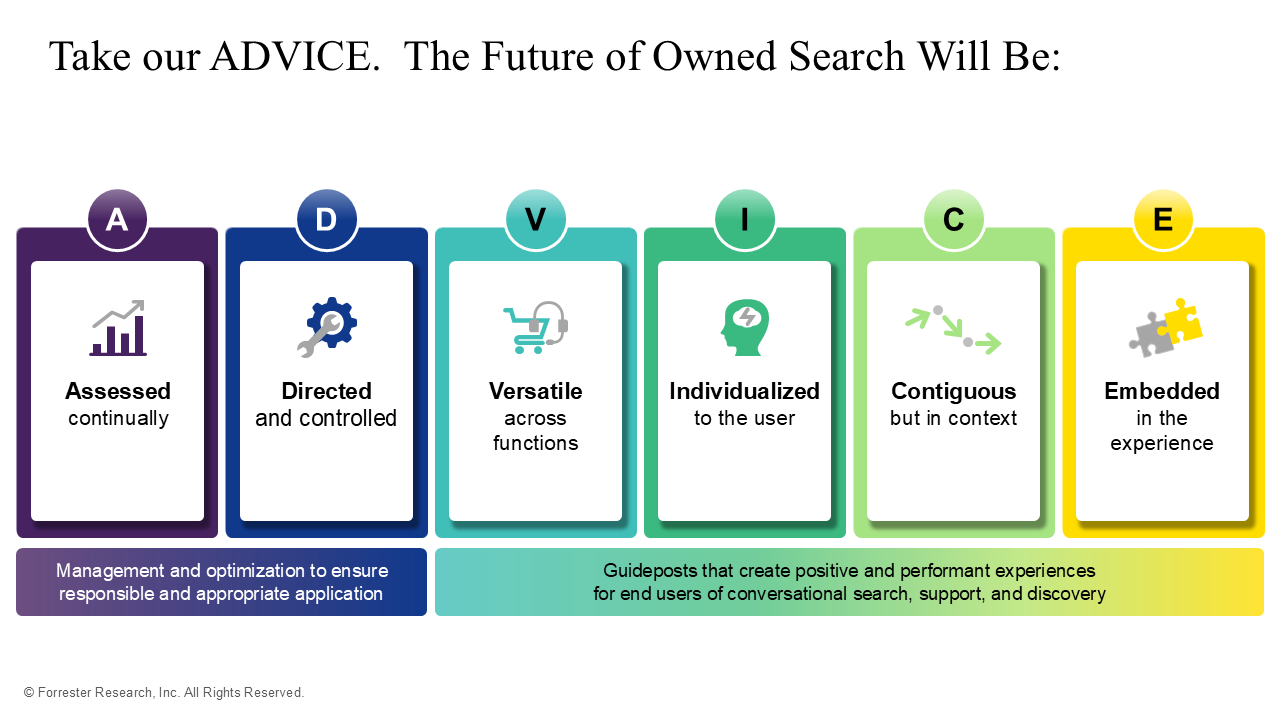
Six Requirements For Conversational Experiences
Conversational experiences are changing how users expect to interact in all environments, including on the apps and websites that organizations control.
Our ADVICE framework gives digital leaders six guideposts to build conversational experiences that earn visitors and give them a reason to stay. The future of owned search experiences will need to be:
- Assessed continually. Systems that learn require constant monitoring and testing. Use new metrics for conversational performance, watch for broken guardrails, and introduce new tools incrementally so you can learn without putting too many user experiences at risk.
- Directed and controlled. Establish (and demand from your vendors) administrative controls, permissions, governance, and evolving guardrails. The system’s answers should remain grounded in data and aligned with the system’s purpose, as well as be consistent with the organization’s voice and limits.
- Versatile across functions. Bring product discovery, customer service, post-purchase support, recommendations, account management, and other activities into one conversational experience. Support the input methods that fit the audience, including text, voice, and images.
- Individualized to the user. Remember relevant behavior, preferences, and prior conversations, including whether the user wants personalization at all. Start with a default or segment-based experience when necessary, but design toward the individual. Users expose much more personal data via conversations than they do when searching broadly, so make sure to judiciously use what they share with you to improve their experience.
- Contiguous but in context. Let the conversation travel across pages and visits while carrying forward what matters. The system must also recognize when a user has changed subjects, at which point prior context should no longer shape the response.
- Embedded in the experience. Move conversations beyond the isolated pop-up. Place it throughout the website or app in consistent, expected locations that support rich information and interaction without hiding the rest of the experience.
Stay tuned for the upcoming full research report with much more depth, as well as concrete advice for what to do right now.
In the meantime, join us on October 7 for the webinar, The Future Of Owned Search In Apps And On Websites!